A First Visit to a Theatre in the Round
A first visit to a theatre in the round feels clearer when you know how to read entrances, follow a scene’s focus and settle into your seat.
A first visit to a theatre in the round becomes easier when you know how to read its entrances and shifting focus. The stage has no fixed front, so the room’s movement—not a single ideal view—helps you follow what is happening.
Instead of trying to track every face, notice how performers use the space: who enters, where they pause, and which object or person draws the group together. Those cues give you a simple way into the production, even when the action changes direction.
Read the playing space before the action starts
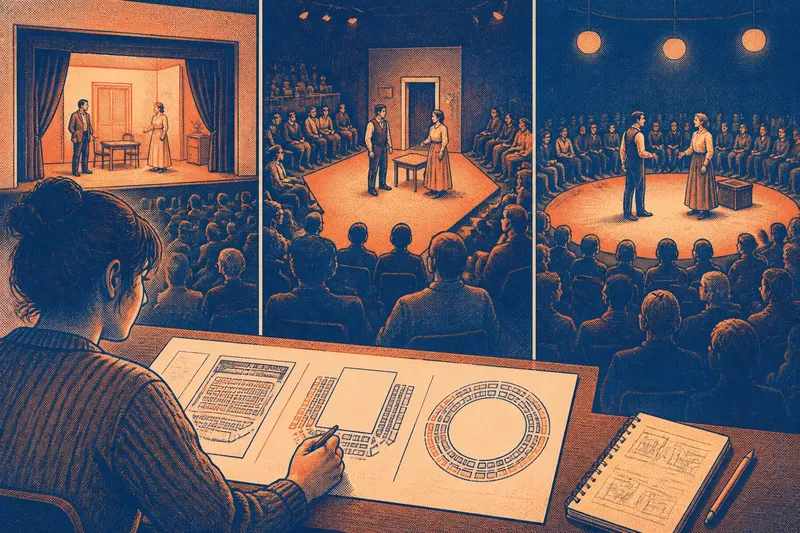
Theatre in the round places the audience around a central playing area. It may be circular, square or another shape, and the performance space may sit on a platform or at floor level. With no single front, entrances, furniture and actor movement help establish where attention is going.
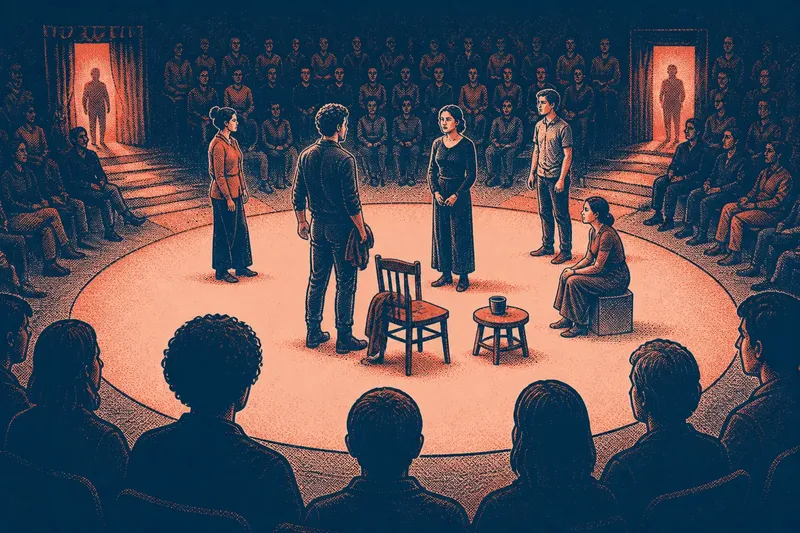
Before the show begins, notice the boundaries of the playing area, any visible doors or aisles, and objects already on stage. A chair placed apart from a group, for instance, may become a meeting point; an entrance behind one section of seats may bring a character into the scene from an unexpected direction.
You do not need to predict the plot from these details. Treat them as landmarks. Once the action starts, they can help you understand where a character has come from and what has changed in the room.
Choose a seat for comfort and orientation
If you have a choice, look at the venue’s seating plan and consider how you prefer to watch. An aisle seat can feel easier to enter and leave, while a place with a little distance from the playing area may make the group’s arrangement easier to take in. A closer seat can make small gestures feel immediate, though another performer may briefly stand between you and the action.
There is no universally best side. The production may shift attention across the room, so choose for comfort rather than trying to forecast where every important moment will happen. If you have an access need or are unsure about a particular seat, ask front-of-house staff before the performance.
Follow the scene’s changing focus
Actors often guide attention through movement, stillness and the way they handle objects. A character who crosses to a table may pull focus; a sudden pause can make the person who remains seated more noticeable. Let these changes direct your gaze rather than treating dialogue as the only cue.
When several performers are active, take in the group’s shape. Notice who is included, who is left apart and whether a shared object changes hands. These relationships can make the scene legible without requiring you to examine every expression.
Imagine you are seated near one entrance and a performer comes in carrying a folded coat. They place it on a chair, and the others stop speaking. You can follow the change by noticing the group’s silence and the chair that has become central; you need not guess the character’s motive before the scene reveals it.
Which viewing choices help you follow the action?
What should I notice first when the performance begins?
Start with the entrances, the boundaries of the playing area and any objects the performers use. These landmarks help you understand where people come from and what changes as the scene develops.
How do I follow a scene with several active performers?
Look at the group’s arrangement, then notice who moves or speaks in response to a change. If your attention feels scattered, settle on the person or object that has just altered the scene.
Should I choose a seat close to the stage?
Choose according to what feels comfortable and the view you prefer. A closer position can make gestures feel immediate, while a little distance can make patterns among the performers easier to read.
What if I cannot see a particular action clearly?
Stay with another available cue, such as a voice, a change in the group or an object being moved. Avoid leaning into the playing space; if seating or access arrangements are a concern, ask venue staff.
Settle into the room without chasing every detail
Arrive with time to find your seat and notice the room’s layout. Keep your posture comfortable and avoid repeated leaning or shifting to seek a perfect angle. Follow the theatre’s guidance on phones, late seating and other practical arrangements.
For a first visit to a theatre in the round, use entrances and objects as landmarks, then let movement show you where the scene’s focus has gone. That approach leaves room for surprises: a small shift in the group may matter more than a view of every face, and the production can make its meaning clear as it unfolds.