Round, Thrust or End-On: Reading Three Audience Layouts
Compare round, thrust and end-on theatre layouts to see how sightlines, performer orientation and shared space shape what an audience can follow.
Begin with the audience’s position
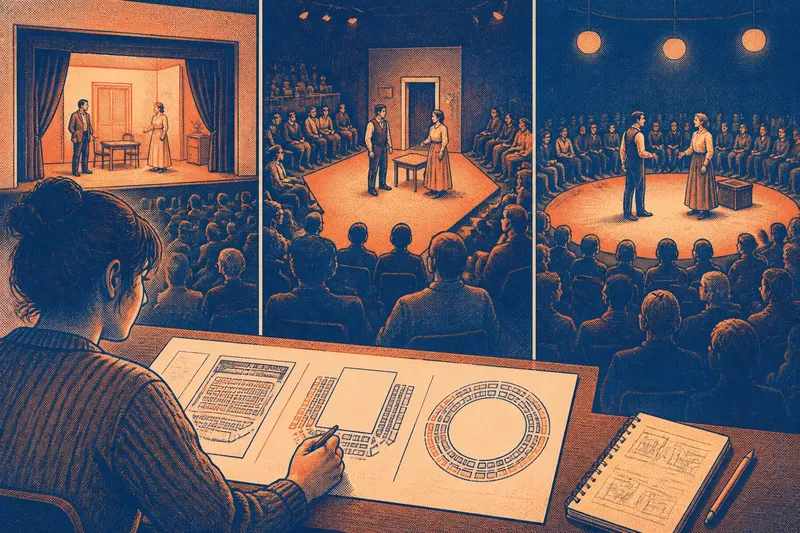
Find the stage area on the plan and note which sides have seats. In an end-on layout, the audience faces the stage from one main direction; in a thrust, the acting area projects into the audience, with seats on three sides; in the round, seats surround the acting area.
Do not treat these labels as exact descriptions of every venue. A thrust may be shallow or deep, and a round space may have gaps for entrances, scenery or technical access. The useful question is not only what the layout is called, but where each audience group sits in relation to the action.
Use a pencil to mark the stage boundary and the main seating blocks on a printed plan. If the venue offers a seating map online, compare it with photographs of the room; the map shows the arrangement, while a photograph can make the stage height, rails and likely obstructions easier to understand.
Trace the sightlines from more than one seat
A sightline is the path between a seat and a point on stage. For each layout, choose a seat near the centre and another towards an outer edge. Imagine looking towards the floor, a seated performer and a raised scenic element: each may produce a different view.
End-on staging offers a strong shared direction. Most spectators see the same front of a set, and a doorway or table can be framed clearly. The trade-off is that a performer or piece of scenery near the front may block what happens further back, especially for seats with a low or sharply angled view.
In a thrust, the audience can see the action from the front and both sides. This can make entrances and gestures feel close, but a performer facing one bank may show their back to another. Scenery that works like a solid wall in an end-on room can also cut off views across the thrust.
In the round, spectators can look across the acting area towards other audience members, and there is no single front that suits every moment. A tall object or a cluster of bodies can interrupt views for several directions at once. Low, open arrangements tend to preserve more of the shared view than scenery with broad, opaque faces.
Compare how performers orient themselves
Performer orientation means how bodies and faces are offered to the audience. In end-on staging, a scene can often be arranged around a principal front, though turning away still changes what spectators can read. A profile may suit a conversation, while a direct address can make the room feel suddenly more personal.
A thrust asks performers to distribute attention across different audience banks. Rather than holding one fixed front, they may angle their bodies, shift their focus, or turn as the scene develops. If a speech is delivered to only one side, the others may receive the words without the facial detail that gives them emphasis.
In the round, orientation is continually shared and redistributed. A turn can bring one group closer while briefly placing another behind the performer. This does not mean every line needs a full rotation: constant turning can look mannered, while a clear change of focus tied to the scene’s action gives spectators a reason to follow.
Notice how each arrangement creates shared space
Shared space is the audience’s sense of being near the same event, rather than watching a distant picture. End-on seating can create a composed, framed view: spectators look in a common direction, and changes in light or scenery can define a clear boundary between stage and auditorium.
The thrust often brings the stage into the audience’s reach. The acting area seems to continue between the seats, and spectators can see other people watching from across it. That closeness may make a quiet exchange feel immediate, though the different viewing angles remain part of the experience.
The round makes the audience’s presence especially visible. People may see other spectators react, and performers are surrounded rather than approached from a single side. The effect can feel collective, but it also makes concealment harder: a movement intended to be private may be visible somewhere in the room.
Say you are comparing plans for a small touring production. Imagine the scene depends on a character hiding a letter while another speaks nearby. In an end-on arrangement, you would check whether the table and actor mask the letter from the back row; in a thrust, you would inspect the side views; in the round, you would consider whether any audience bank can see the hiding action. The useful result is a staging question to resolve, not a claim that one layout is universally best.
Choose the layout that serves the scene
Read the scene’s central visual action, then match it to the room. A picture-like composition with a clear front may benefit from end-on seating. A scene that gains from closeness and several angles may suit a thrust. An exchange built around visible relationships among performers and spectators may make productive use of the round.
Also consider what the audience must follow. If a crucial object, facial expression or movement can disappear from some seats, the arrangement may need a different blocking choice or simpler scenery. These adjustments are part of writing for the room, not evidence that a layout has failed.
For a real venue, use its seating plan and, where possible, view the room from the seats you are considering. A camera image from the centre may hide an obstruction at the side, and a stage diagram cannot fully convey how high or close the playing area feels.
What should you check before settling on a layout?
Which seats lose the important action?
Trace the view to the scene’s essential object, gesture or expression from the centre and outer seating areas. If one group repeatedly misses it, consider changing the arrangement of performers or scenery.
Does the scene need one clear front?
A composed visual image may be easiest to read end-on, while action that benefits from several angles can make sense on a thrust or in the round. Decide what the scene asks spectators to notice before choosing the room.
How should performers share their focus?
Consider which audience banks need a clear view of each exchange. In a thrust or round, plan deliberate shifts of orientation so attention moves with the action rather than falling repeatedly on the same seats.
How close should the audience feel?
Think about whether spectators should feel like observers of a framed scene, nearby witnesses or part of a surrounding group. The layout shapes that relationship alongside the performers’ movement and the openness of the set.
When comparing round, thrust and end-on layouts, judge each from the audience’s actual viewing positions, not from the plan alone. A room works best for a scene when its sightlines and shared space help the audience notice what the performance means to show.