The Prompt Book Before the Modern Rehearsal Room
Learn how a prompt book supported performance before modern rehearsal rooms, and how to read its cues, revisions and gaps without overclaiming.
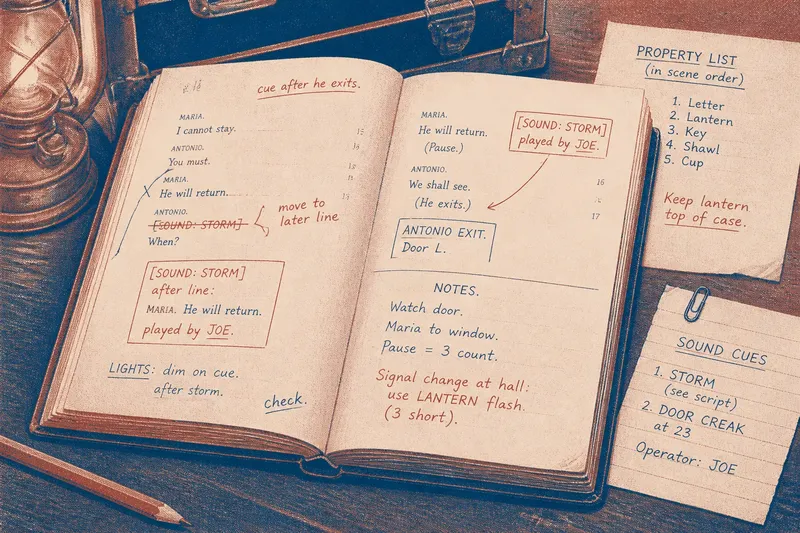
A prompt book made a performance easier to repeat by gathering cues and practical instructions in one working document. The prompt book before the modern rehearsal room was not a single standard format: its contents depended on the company, the play and the work its keeper needed to coordinate.
That distinction matters when reading the history of stage management. A marked script can show where a cue was called or a property prepared, but it cannot, by itself, tell us everything actors and directors tried in rehearsal.
Prompt books preserve working decisions, not a standard system
“Prompt book” is a broad term for a script or related document annotated to help a performance run. It might contain entrances and exits, cue points, scene-change notes, property reminders or other instructions. There was no single arrangement that every company had to follow.
A cue is a signal for an event to happen, such as starting a sound or changing the scenery. Placing a cue beside the relevant line or action helps its user locate the moment quickly. Other information might sit in a separate list or on an inserted sheet if it did not fit neatly into the script.
The surviving marks reflect what someone chose to write down for practical use. They may record a settled instruction while leaving out the debate, experiments and performances that led to it.
Historical claims need to stay close to the surviving page
Without a particular dated book or archival description to examine, it would be misleading to assign one set of contents to all prompt books from before the modern rehearsal room. The period covers varied theatrical settings, and a general description cannot establish what every company used.
A reader can still make careful observations about an individual document. A cue beside a speech, a list of scene changes or a note about a prop shows that the keeper considered that detail useful to the production. It does not establish how common that practice was elsewhere or what the whole rehearsal process looked like.
Handwriting and shorthand may have made a page quick to use for its original keeper but hard for a later reader to decode. A sparse page does not prove that little rehearsal took place; it may simply mean that the document had a narrow job.
A hypothetical touring company turns loose notes into a working book
Imagine a hypothetical touring company with a marked script, a property list and loose notes for two sound cues. Its starting problem is concrete: the caller cannot tell which sound instruction is current, and the property reminder is difficult to find during a run.
The stage manager first copies the two sound cues beside the lines that trigger them, naming each sound and the person responsible for playing it. The manager then puts the property reminder on a separate list in scene order, so the information is easy to scan without crowding the script.
During rehearsal, the director moves the first sound cue to a later line. The stage manager crosses out the old mark, writes the replacement beside the new line and checks that only one current cue remains. On the next run, the caller can identify the intended point without having to choose between conflicting notes.
At the hired hall, the company discovers that the sound operator cannot hear the caller clearly from the planned position. The manager adds a venue-specific instruction to use a visible signal instead. The resulting book distinguishes the play’s cue point from the local method of communicating it; it still does not record why the director preferred that timing or what other options the company considered.
What can a prompt book tell a later reader?
Does a prompt book show everything that happened in rehearsal?
No. It records the details its keeper chose to preserve, often those needed to repeat cues and practical arrangements. Discussion, experiments and personal interpretations may not appear.
Why do prompt-book marks and abbreviations vary?
Notation follows the needs and habits of the people using a particular book. A mark might refer to a sound, performer or department, so look for a key or a repeated pattern before assigning it a meaning.
Can a prompt book show who made a decision?
A signature or recognisable hand may identify who entered a note, but not necessarily who proposed it. The document may leave the discussion and decision-making process unrecorded.
How should a damaged or incomplete prompt book be read?
Describe what remains visible, such as the text, page order and repeated marks, and note where material is missing or unclear. A gap is not evidence that an instruction or event was absent from the production.
Read revisions and venue notes in their context
Start by distinguishing the play’s text from later additions. A pencil mark or inserted sheet may show a performance instruction, but its position and surrounding notes matter. A cue beside a line may identify a calling point; on its own, it does not explain the intended acting style.
Then check whether an instruction belongs to the production generally or to one venue. A note about a backstage route or a signal may describe a local arrangement that changed on tour, while the cue itself remained in place.
Corrections can show that an instruction changed. A crossed-out cue followed by a replacement establishes a revision on the page, but not its cause; timing, equipment or another consideration might have prompted it. State what the marks support and keep explanations tentative unless other evidence clarifies them.
Physical condition also sets limits. A loose insert may have been added later, a missing page may interrupt the sequence, and faded handwriting may resist confident reading. Recording those limits is more useful than smoothing them over.
Use a prompt book as evidence with clear limits
A rehearsal is a process involving attempts, listening and choices made with other people. A prompt book is a selective record designed for a particular use. It may preserve the cue that emerged from discussion while omitting the discussion itself.
For the hypothetical touring company, the finished book helps the caller follow the revised sound cue and prepare the property. A later reader can identify those instructions and the venue-specific signal, but cannot reconstruct the full rehearsal or establish how common those choices were in other companies.
When researching a particular prompt book, record its title or identifying details, note which marks are legible and distinguish direct observations from interpretations. That simple separation keeps the document useful as evidence without asking its silences to answer questions it was never made to hold.